



Carpet Tile Acoustics: NRC and Impact Sound
TL;DR
Independent SGS testing of UNIJOY nylon loop-pile carpet tile with PVC/PET backing (500×500×9 mm) measured a Noise Reduction Coefficient of NRC 0.25 to ISO 354:2003 and an impact sound improvement of ΔLw 28 dB to ISO 10140-3:2021. The absorption is not flat: it peaks at 0.48 at 500 Hz and stays between 0.24 and 0.43 from 800 Hz to 5 kHz — the band that carries human speech — while absorption below 250 Hz is close to zero. Impact improvement rises with frequency, from about 3 dB at 100 Hz to 56 dB at 1250 Hz. Practically: carpet tile is highly effective against footfall noise for the floor below and useful against speech-range reverberation in the room itself, but it does almost nothing for low-frequency rumble and is not a substitute for ceiling absorption or partition sealing.
1. Two metrics that get confused
Almost every noise complaint in a commercial building is one of two problems, and flooring is asked to solve both. They are not the same problem, they are not measured the same way, and a product can be strong at one and ordinary at the other.
| Sound absorption | Impact sound insulation | |
|---|---|---|
| The complaint | “This room echoes, I can hear every conversation” | “I can hear footsteps and chairs from the floor above” |
| Who benefits | People in the same room | People in the room below |
| Metric | NRC / αs | ΔLw (improvement), Ln,w (residual) |
| Test standard | ISO 354:2003, reverberation room | ISO 10140-3:2021, tapping machine |
| UNIJOY measured | NRC 0.25 (ᾱs 0.23) | ΔLw 28 dB (Ln,w 48 dB) |
| Scale | 0 to 1; higher absorbs more | dB improvement; higher is better |
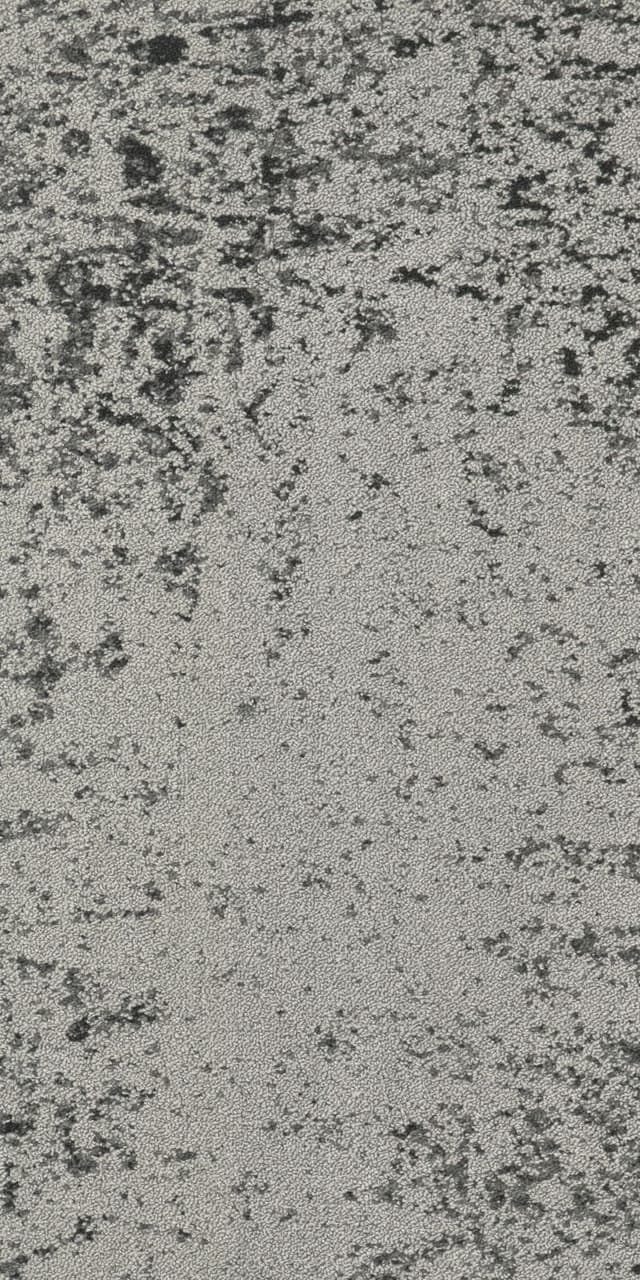
Both figures come from the same sample: tufted nylon loop pile on PVC/PET backing, 500 × 500 × 9 mm, surface density about 3.68 kg/m², tested by SGS in March 2026. The report numbers are listed in the sources at the end so an acoustic consultant can request the originals.
2. The absorption curve, frequency by frequency
Absorption happens at the surface. Sound energy entering the pile is scattered between the fibres and converted to a very small amount of heat instead of being reflected back into the room, which is why the density and structure of the face matter more than the thickness of the tile.
NRC is a single number averaged from four octave bands (250, 500, 1000 and 2000 Hz). It is convenient and it hides almost everything interesting. Here is the full one-third-octave curve from the ISO 354 test.
Two things stand out, and neither is visible in the NRC number.
The peak sits at 500 Hz. Absorption jumps from 0.19 at 400 Hz to 0.48 at 500 Hz, then settles into a broad plateau between 0.24 and 0.43 across the rest of the measured range. That band — roughly 500 Hz to 4 kHz — is where the intelligible content of human speech lives. In an open-plan office the problem is rarely raw loudness; it is that you can make out the words of a conversation three desks away, which is what pulls attention away from focused work. A floor that absorbs most in the speech band is doing the useful part of the job even at a modest overall NRC.
Below 250 Hz the floor does essentially nothing. The coefficient reads 0.02 at 100 Hz and 0.00 at 125 Hz. Low-frequency energy — HVAC rumble, lift machinery, traffic through a facade — passes straight through a 9 mm textile layer. If that is the complaint on site, carpet is not the remedy and no carpet specification will change it.
3. Impact sound: ΔLw 28 dB in context
Impact sound is measured by dropping a standardised tapping machine on the floor and recording the level in the room below, first on the bare slab and then with the covering in place. The difference, weighted into a single number, is ΔLw.
The curve climbs steeply: about 2.8 dB of improvement at 100 Hz, 16.8 dB at 250 Hz, 37.3 dB at 500 Hz and 55.6 dB at 1250 Hz. The pattern matches the absorption result — a soft, porous layer is progressively more effective as wavelengths get shorter — and it maps well onto the noise people actually complain about. The sharp, clicking part of a footstep or a rolling chair caster is mid-to-high frequency energy, and that is exactly where this covering removes the most.
For scale: a change of roughly 10 dB is perceived as a halving of loudness. A weighted improvement of 28 dB is therefore a very large subjective reduction in footfall noise for the space below, which is why carpet remains the default specification for upper floors in offices, hotels and multi-tenant buildings.
| Floor covering | Impact sound improvement | Source of figure |
|---|---|---|
| Bare concrete slab | reference (0 dB) | definition of the test |
| Hard surface flooring, typical | 1–6 dB | Interface, published range |
| 4.5 mm LVT with acoustic backing | 16 dB | Interface, published figure |
| 4 mm acoustic rubber flooring | ΔLw 20 dB | nora, published figure |
| UNIJOY nylon carpet tile, 9 mm | ΔLw 28 dB | SGS CZIN2603000210CM02_EN |
These figures come from different laboratories, sample build-ups and slab constructions, so they indicate the general standing of each material family rather than a controlled head-to-head comparison. Textile floor coverings are expected to lead on impact sound; that is a property of soft, porous materials, not a claim about any one manufacturer.
4. How to specify acoustics properly
Most acoustic disappointments trace back to a specification that named a number without naming the conditions that produce it. This is the sequence that avoids that.
Step 5 is the one most often skipped. An acoustic result belongs to a specific build-up. A figure measured on a 9 mm tile with PVC/PET backing does not transfer to the same pattern supplied on a different backing, and a result measured on a bare slab does not transfer to a raised access floor, which has its own cavity behaviour. When a substitution is proposed late in a project, the acoustic report has to be re-checked along with the price.
5. What carpet tile cannot do
Being straight about the boundaries is more useful than a page of superlatives, and it is the part of the conversation an acoustic consultant will have anyway.
- It will not fix low-frequency noise. Measured absorption is 0.02 at 100 Hz. Plant rumble, lift motors and traffic ingress need mass, isolation or source treatment.
- It will not replace ceiling absorption. Dedicated acoustic ceiling products reach NRC 0.9 and above, and a ceiling faces the whole room. A floor at NRC 0.25 is a useful base layer, not the main event.
- It will not stop speech travelling between rooms. That is airborne transmission through partitions, doors and the ceiling void, and it is solved by sealing and mass, not by the floor finish.
- It will not compensate for an open plan with no screens. Absorption reduces reflected energy; it does nothing to the direct sound path between two people with clear line of sight.
Where carpet tile is genuinely hard to beat is impact noise for the floor below, and broadband absorption in the speech range across a very large surface area at a cost per square metre that no dedicated acoustic product matches.
Frequently asked questions
What is a good NRC for carpet tile?
Commercial carpet tile generally falls between NRC 0.15 and 0.35, so an NRC of 0.25 sits in the middle of the normal range. Values far above that usually indicate a thick cushion backing or an underlay, not the tile alone. Treat any NRC quoted without a test standard and report number as unverified.
What is the difference between NRC and ΔLw?
NRC describes sound absorption — how much sound the floor stops reflecting back into the room you are standing in. ΔLw describes impact sound improvement — how much footfall and chair-scrape noise is stopped from reaching the room below. They are measured by different standards (ISO 354 and ISO 10140-3) and solve different complaints.
Does carpet tile reduce noise between floors?
It substantially reduces impact noise transmitted downward. UNIJOY tile measured ΔLw 28 dB, and because roughly 10 dB is perceived as a halving of loudness, that is a large reduction in footfall noise for the tenant below. It does far less for airborne sound such as speech or music travelling through the structure, which is governed by the slab and the partitions.
Is thicker carpet always quieter?
Not reliably. Absorption depends on fibre density, pile structure and backing porosity, not thickness alone, and a dense low-pile loop can outperform a thicker cut pile. Thickness also has trade-offs elsewhere: in transport hubs and heavy-traffic areas, thick pile makes wheeled loads harder to move and crushes faster.
Will carpet tile fix an echoing open-plan office on its own?
No. A floor is one surface out of six, and it is the surface people stand on rather than the one most sound reflects off. Carpet tile is best treated as the base layer of an acoustic strategy that also includes ceiling absorption, screens between desk banks, and sealed meeting rooms.
What test documents should I ask a supplier for?
Ask for the full test report, not a summary line in a brochure. It should name the issuing laboratory, a report number, the test standard and edition, the sample construction and dimensions, and the frequency-by-frequency results. A single number with no traceable report behind it cannot be verified by your acoustic consultant.
Sources & further reading
- ISO 354:2003 — Acoustics: Measurement of sound absorption in a reverberation room
- ISO 10140-3:2021 — Laboratory measurement of impact sound insulation
- CRI Technical Bulletin — Acoustical Characteristics of Carpet
- Interface — Acoustics in flooring (published product figures)
- Carpet Institute of Australia — Acoustic benefits of carpet
- UNIJOY — Sound Absorption Coefficient test report (SGS CZIN2603000210CM01_EN)
- UNIJOY — Impact Sound Insulation test report (SGS CZIN2603000210CM02_EN)
Figures attributed to other manufacturers are their own published values, quoted for context. Different laboratories, sample build-ups and substrates are not directly comparable.