



Office Carpet Tile Specification: A Buyer Checklist
TL;DR
For an office renovation, specify the carpet tile that will be installed, not just a collection or a broad ‘commercial’ label. Record the exact series, code, colour, tile size, fibre, pile construction, backing and total thickness for each candidate. Then add the room, traffic, chair use, layout, adjoining finishes and cleaning plan. A named sample and current product sheet make the request clear to designers, installers and suppliers; a common work scope makes the quotes comparable.
Start with rooms and real product codes
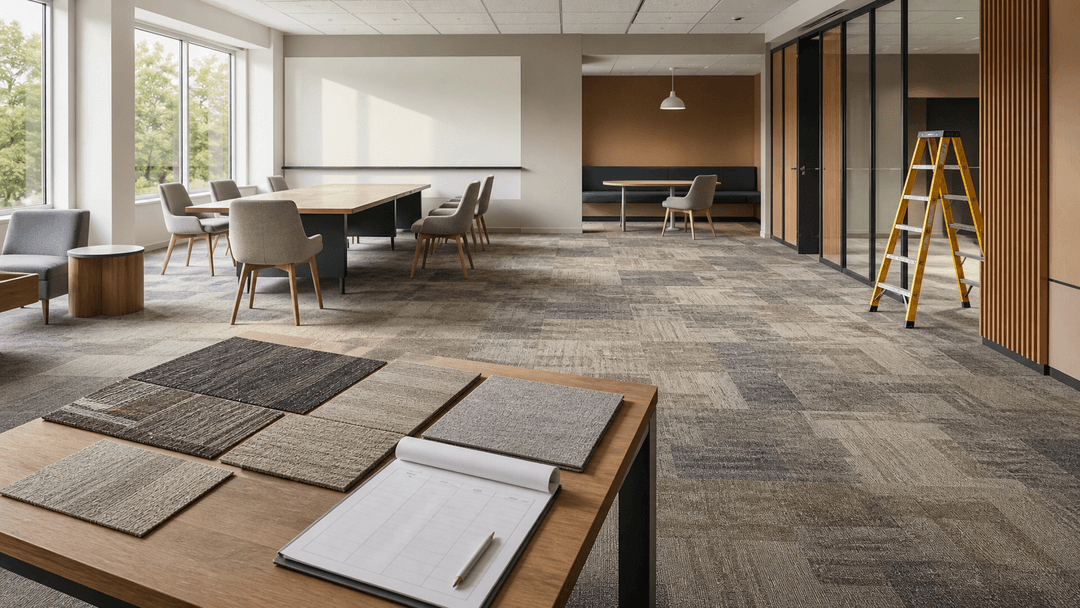
A renovation can involve an occupied desk area, corridor, meeting room and reception with different use patterns. The Carpet and Rug Institute recommends choosing commercial carpet for the particular facility area, then considering construction, installation and maintenance. Use a room schedule rather than one vague floor-covering line for the whole office.
Compare the same product fields
For each zone, note the floor area, existing substrate, furniture moves and any access under the floor. Put two or three tile codes in columns with their face fibre, pile, backing, size and thickness. Review full-size samples beside the room finishes. Mark required fire, emission, acoustic or other project documents as separate requests tied to the exact product, where the brief calls for them.
| Product identity | UNIJOY series plus exact style/code; colourway, module and approved-sample reference if available. |
|---|---|
| Construction | State the reported fibre/yarn, construction, pile information, total thickness and any stated mass fields from the current product sheet. |
| Backing | Record the named backing and ask for the current sheet or report that applies to the proposed construction. |
| Project zone | Record the office area, expected use, adjacent finishes, layout direction, transitions and unresolved site questions. |
| Installation interface | Request current product-specific guidance and identify subfloor, adhesive, acclimatisation or coordination questions separately. |
| Evidence file | Keep the current specification, report/certificate if requested, issue date, scope, sample reference and reviewer decision together. |
Send a useful specification enquiry
Ask suppliers to price the same measured area, installation phases, floor preparation assumptions, layout, waste allowance and spare stock. Keep the current product sheet, accepted sample and drawing revision with the chosen code. If the renovation conditions change, update the schedule before comparing a substitute.
- Open the live catalogue and record a UNIJOY series plus exact style/code before comparing anything else.
- Set the office zones, layout direction, adjacent finishes and the decision owner; write unknowns as pending.
- Copy only current product-sheet fields into the comparison record—do not fill gaps with marketing language.
- Request each separate report, certificate or declaration by product identity, date/version and stated scope.
- Keep installation-interface questions separate from product fields and request current guidance for the proposed product.
Browse current carpet tiles · Request a specification review
Frequently asked questions
What is the first field on a commercial carpet tile specification checklist?
Start with the exact proposed product identity: series, style/code, colourway and module, with an approved-sample reference if one exists. A collection name or room image alone cannot control the comparison.
Does “commercial grade” prove a carpet tile is suitable?
No. It is a broad label. The project team still needs the named product, construction fields, intended zone, current documents and a separate review of installation conditions.
Can thicker or heavier carpet tile replace a specification review?
No. Thickness or mass is only one reported field. It does not alone prove wear, acoustics, dimensional stability, fire, emissions, certification scope or suitability for a particular project.
Which documents should accompany an office carpet tile decision?
Request the current specification and any separate report, certificate or declaration required by the brief, each tied to the proposed product identity, date/version and stated scope. Keep site and installation questions separately visible.
Sources & further reading
- Carpet and Rug Institute — Model Specifications for Commercial Carpet
- Carpet and Rug Institute — CRI 104 Commercial Carpet Installation Standard
- Carpet and Rug Institute — Finding the Right Carpet
Figures attributed to other manufacturers are their own published values, quoted for context. Different laboratories, sample build-ups and substrates are not directly comparable.