



Carpet Tile Thickness: Coordinate Pile, Doors and Adjacent Floors
TL;DR
Pile height describes the face pile; total thickness describes the product from its top surface to the underside. Installed finished floor height adds the prepared substrate, approved fixation layer and real site tolerances. Use the same field, unit and measurement basis when comparing codes, then place the actual sample at doors, transitions, access panels and floor boxes before approval. Current UNIJOY records show why the distinction matters: Ancient 55905 publishes 4.0 ± 0.5 mm pile height and 6.5 ± 0.5 mm total thickness, while Rhythm Flow 51902 publishes 5.0 ± 0.5 mm and 8.0 ± 0.5 mm respectively.
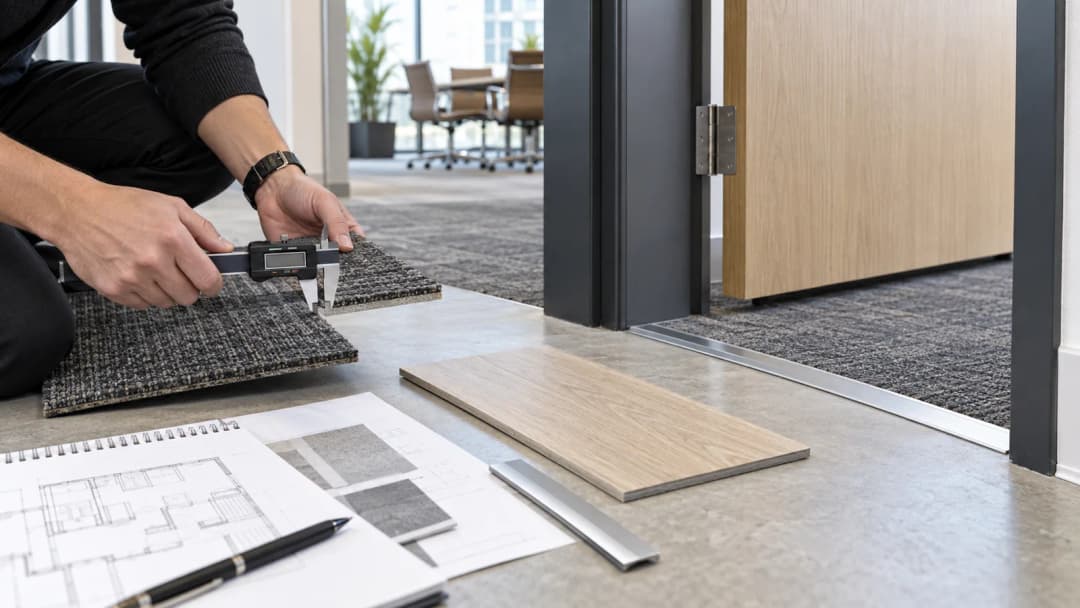
Separate the three height fields
Use three separate lines in the schedule. Pile height identifies the textile face above its supporting layer. Product total thickness covers the full carpet tile. Installed finished floor height is a site result that also includes the prepared base, approved fixation layer and construction tolerance.
The distinction is practical: pile height helps read surface profile and door contact risk, total thickness starts product-to-product and transition coordination, and the installed level decides the final door, trim, access-panel and floor-box detail.
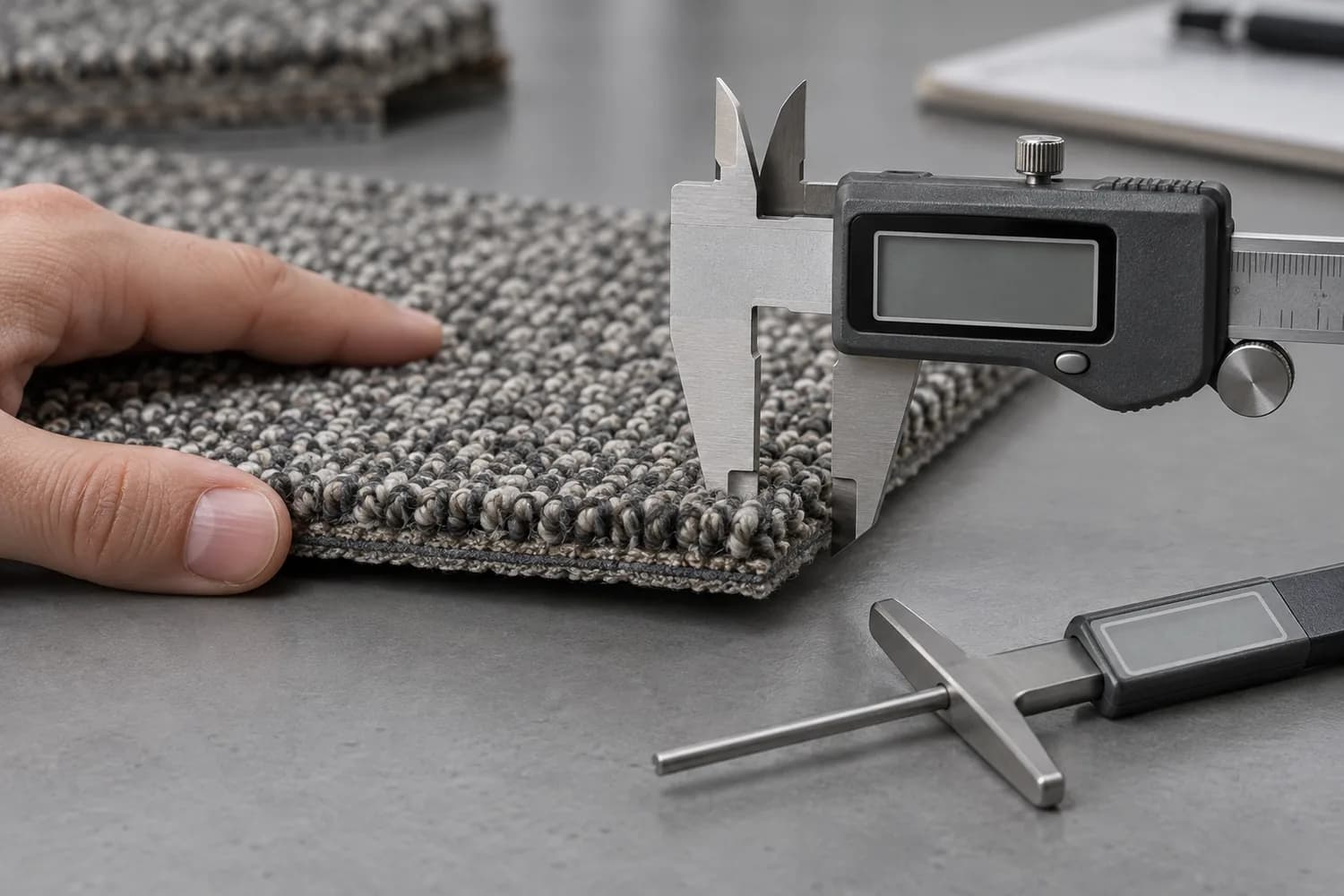
Compare current product records
UNIJOY Ancient 55905 currently publishes pile height 4.0 ± 0.5 mm and total thickness 6.5 ± 0.5 mm with TGDURA Bac®. Rhythm Flow 51902 publishes 5.0 ± 0.5 mm and 8.0 ± 0.5 mm with TGLITE® Bac. Surge 21902 publishes 6.0 ± 0.5 mm and 10.0 ± 0.5 mm with TGFLEX® Bac.
These are current code-specific catalogue fields, not a ranking. They show why a buyer must keep the field names, units and code identity together.
Ancient 55905 · Rhythm Flow 51902 · Surge 21902
| Field | What it includes | Decision it supports |
|---|---|---|
| Pile height | Textile pile above its supporting layer | Surface profile and first door-contact review |
| Product total thickness | Complete carpet tile from top to underside | Product comparison, transitions and access details |
| Fixation layer | Installed adhesive/release/fixation build-up | Installed carpet-side level |
| Finished floor height | Prepared base + installed system | Door, floor box, trim, ramp and adjacent floor |
| Tolerance / datum | Stated measurement tolerance and common reference level | Whether two dimensions are genuinely comparable |
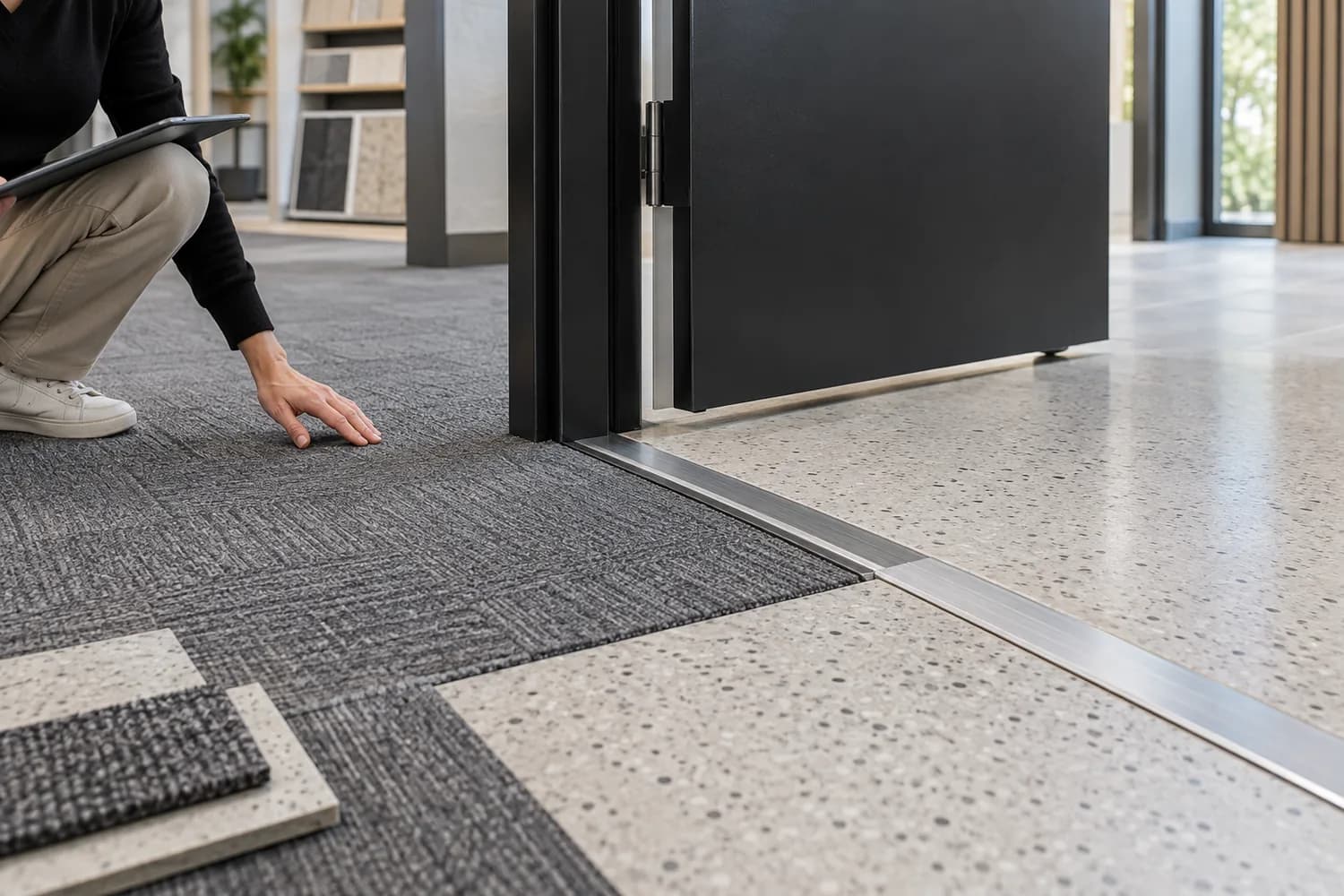
Resolve doors and transitions
At a door, review the clearance through the full swing, not only the gap at one position. At a hard-floor junction, select the transition profile after both finished levels and edge conditions are known.
For raised access floors and floor boxes, check that the carpet and fixation do not prevent panels, lids or service parts from opening. Record the accepted sample build-up on the detail drawing.
Run a teaching calculation
Teaching example: a selected sample publishes 6.5 mm total product thickness. The project team records a 0.5 mm installed fixation layer and a prepared adjacent finish at 8.0 mm above the same datum. The carpet-side planning height is 6.5 + 0.5 = 7.0 mm, leaving a 1.0 mm difference for the transition detail. These numbers are instructional only and are not UNIJOY product or installation data.
Repeat the calculation with the approved adhesive or fixation thickness, site datum and actual adjacent material. The installer then verifies the mock-up before ordering transition profiles.
Issue the technical handoff
The designer issues datum, door, transition, ramp or trim and floor-box details. Procurement holds the exact code, units, document revisions and sample approval. The supplier returns current product fields and installation documents. The installer confirms substrate, fixation and built height on site.
Close the loop with one signed sample and a marked detail. If product, backing, fixation or adjacent material changes, update the height check before order.

Compare current products · Read pile and total weight fields · Read backing-system selection · Open the RFQ template · Send a technical enquiry
Frequently asked questions
Is carpet tile pile height the same as total thickness?
No. Pile height concerns the textile face; total thickness spans the full product. Use total thickness as the product-level starting field for junction coordination.
Does total thickness equal installed floor height?
No. Installed height also reflects substrate preparation, the approved fixation layer and site tolerances, so verify it with the real assembly and sample.
What should be checked at a doorway?
Check door undercut and swing, transition profile, the adjacent finish, edge security, accessibility and the level difference using the actual shortlisted materials.
How should two carpet tile codes be compared?
Place pile height against pile height and total thickness against total thickness in the same unit and measurement basis, then compare physical samples at the project detail.
Sources & further reading
- UNIJOY — Ancient 55905 current specification fields
- UNIJOY — Rhythm Flow 51902 current specification fields
- UNIJOY — Surge 21902 current specification fields
- ISO 1765 — machine-made textile floor coverings, total thickness
- ISO 1766 — textile floor coverings, thickness of pile
- Interface — On Line product specification example
- Carpet and Rug Institute — commercial carpet installation information